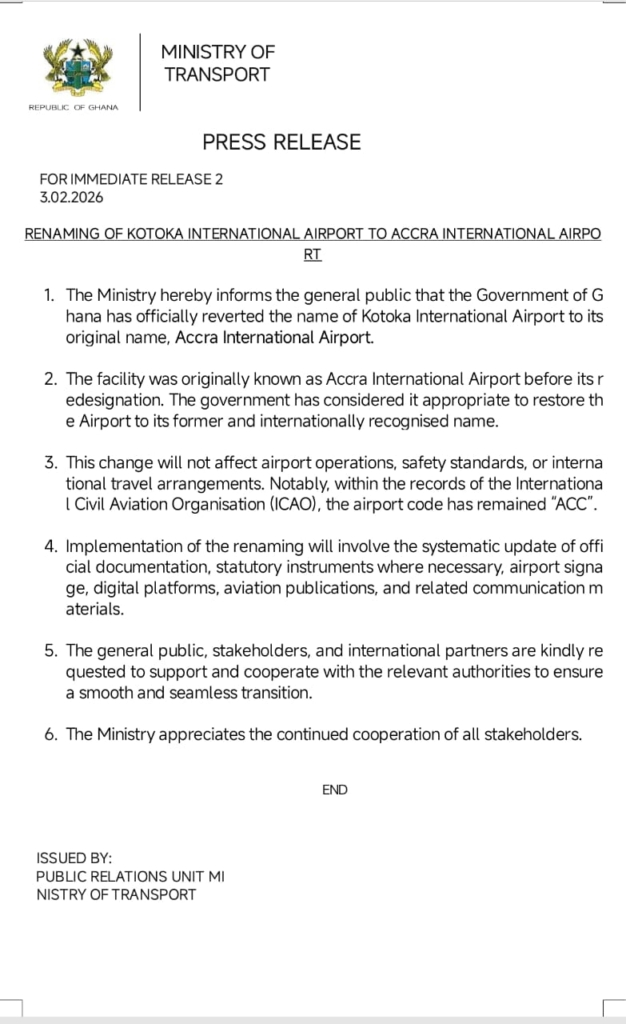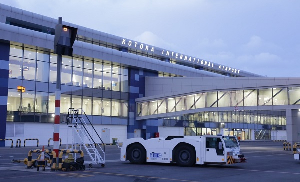
The Government has officially reverted the name of Kotoka International Airport to Accra International Airport, restoring the facility to what authorities describe as its former and internationally recognised name.
In a statement issued by the Ministry of Transport, the airport was originally known as Accra International Airport before its name was changed.
The Ministry explained that it had become necessary and appropriate to reinstate the original name in line with historical records and international recognition.
The Ministry assured the public that the renaming will not affect airport operations, safety standards, or international travel arrangements.
It further clarified that the airport code “ACC,” as registered with the International Civil Aviation Organization (ICAO), has always remained unchanged and will continue to be used.
According to the statement, the renaming process will involve a systematic update of official documentation, statutory instruments, airport signage, digital platforms, aviation publications, and other related communication materials to ensure consistency across all sectors.
Government has therefore called on the general public, stakeholders, and international partners to cooperate with the relevant authorities to guarantee a smooth and seamless transition.
The Ministry also expressed appreciation to stakeholders for their continued support.
The debate over the renaming of the airport intensified over the past month after the Majority Leader announced on February 3 plans to introduce a bill to revert the facility to its original name.
The move was presented as a way to honour the Ga people whose lands were acquired for the construction of the airport and to address concerns raised by some groups about commemorating an unconstitutional regime change.
The proposed legislative action sharply divided public opinion. Supporters, including Bongo MP Charles Bawaduah, argued that reverting the name would project Ghana as a strong democracy by ensuring that its main international gateway does not memorialise the overthrow of an elected government.
However, the proposal faced strong opposition from Minority Leader Alexander Afenyo-Markin, who described it as a betrayal of the Volta Region, the home region of General Emmanuel Kwasi Kotoka.
He criticised what he termed as the silence of some senior political figures, arguing that one of the few national symbols recognising heroism from the Volta Region was being removed.
Below is the full statement