


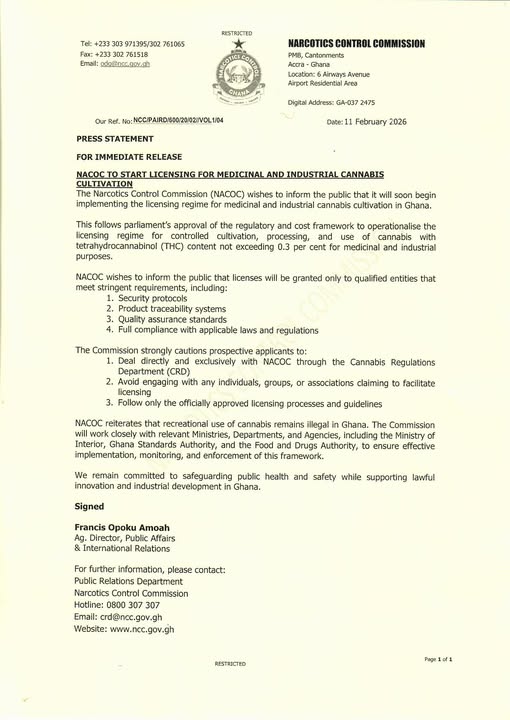
On February 11, 2026, the Narcotics Control Commission (NACOC) issued a press statement titled “NACOC to Start Licensing for Medicinal and Industrial Cannabis Cultivation.”
The statement followed parliamentary approval of a regulatory framework that allows for the controlled cultivation of cannabis strictly for medicinal and industrial purposes.
Following the announcement, sections of the Ghanaian public expressed mixed reactions. While some welcomed the move as a step toward economic growth and medical advancement, others, including health professionals and some religious leaders, criticized the decision, citing concerns about potential misuse and weak regulatory enforcement.
One of the outspoken critics is the General Overseer of the Counsel of God Church at Bronkong-Afrancho, Rev. John Osei Ofori.
In an interview with GhNewsday Online, Rev. Osei Ofori stated that he does not oppose the licensing of cannabis cultivation for medicinal and industrial purposes in principle.
However, he questioned the country’s ability to effectively regulate and control its use.
According to him, many advanced countries have legalized cannabis under strict regulatory systems, but Ghana often struggles with enforcing its own laws. He warned that without strong supervision and enforcement mechanisms, the policy could be abused.
He further expressed concern that the decision could worsen social challenges, claiming that even before legalization, there were already many mentally unstable individuals on the streets.
He cautioned that improper regulation could aggravate the situation.
Rev. Osei Ofori stressed that if the government is unable to properly control and monitor the licensing process, it should reconsider or halt the implementation.
He also added that he expected national leaders to prioritize other moral and social issues, particularly calling for the abolition of the LGBTQ+ Bill, rather than focusing on cannabis legalization.
The debate surrounding NACOC’s decision continues to generate national conversation, as stakeholders weigh the potential economic and medical benefits against social and regulatory concerns.

Background:
Narcotics Control Commission to Begin Licensing Cannabis Cultivation for Medicinal and Industrial Use
The Narcotics Control Commission (NACOC) has announced plans to commence the licensing of cannabis cultivation for medicinal and industrial purposes, following Parliament’s approval of the necessary regulatory framework.
The decision comes after lawmakers endorsed a comprehensive regulatory and cost structure that permits the controlled cultivation, processing, and utilisation of cannabis containing no more than 0.3 per cent tetrahydrocannabinol (THC) strictly for medicinal and industrial applications.
NACOC indicated that licences will be issued only to qualified entities that satisfy rigorous requirements.
These include the implementation of strong security measures, effective product traceability systems, adherence to quality assurance standards, and full compliance with all relevant laws and regulations governing the sector.
The Commission has cautioned prospective applicants to deal directly with NACOC through its Cannabis Regulations Department (CRD).
It warned against engaging intermediaries or individuals who claim to facilitate the licensing process, stressing that only officially sanctioned procedures and guidelines will be recognised.
Francis Opoku Amoah, Acting Director of Public Affairs and International Relations at NACOC, reiterated that recreational cannabis use remains illegal in Ghana.
He assured the public that the Commission will collaborate closely with key institutions, including the Ministry of the Interior, the Ghana Standards Authority, and the Food and Drugs Authority, to ensure strict monitoring, enforcement, and the safe implementation of the new licensing regime.
According to NACOC, the initiative is designed to protect public health while fostering lawful innovation and supporting industrial growth within Ghana’s emerging cannabis industry.
Story by Henry Ameyaw
